Do you actually need this?
Required by lawDo you need a new fire risk assessment every year?
For a small shop or office the answer is usually no. Your own yearly review is the annual job. Larger premises and higher risk ones are different. Here is how to tell which one you are.
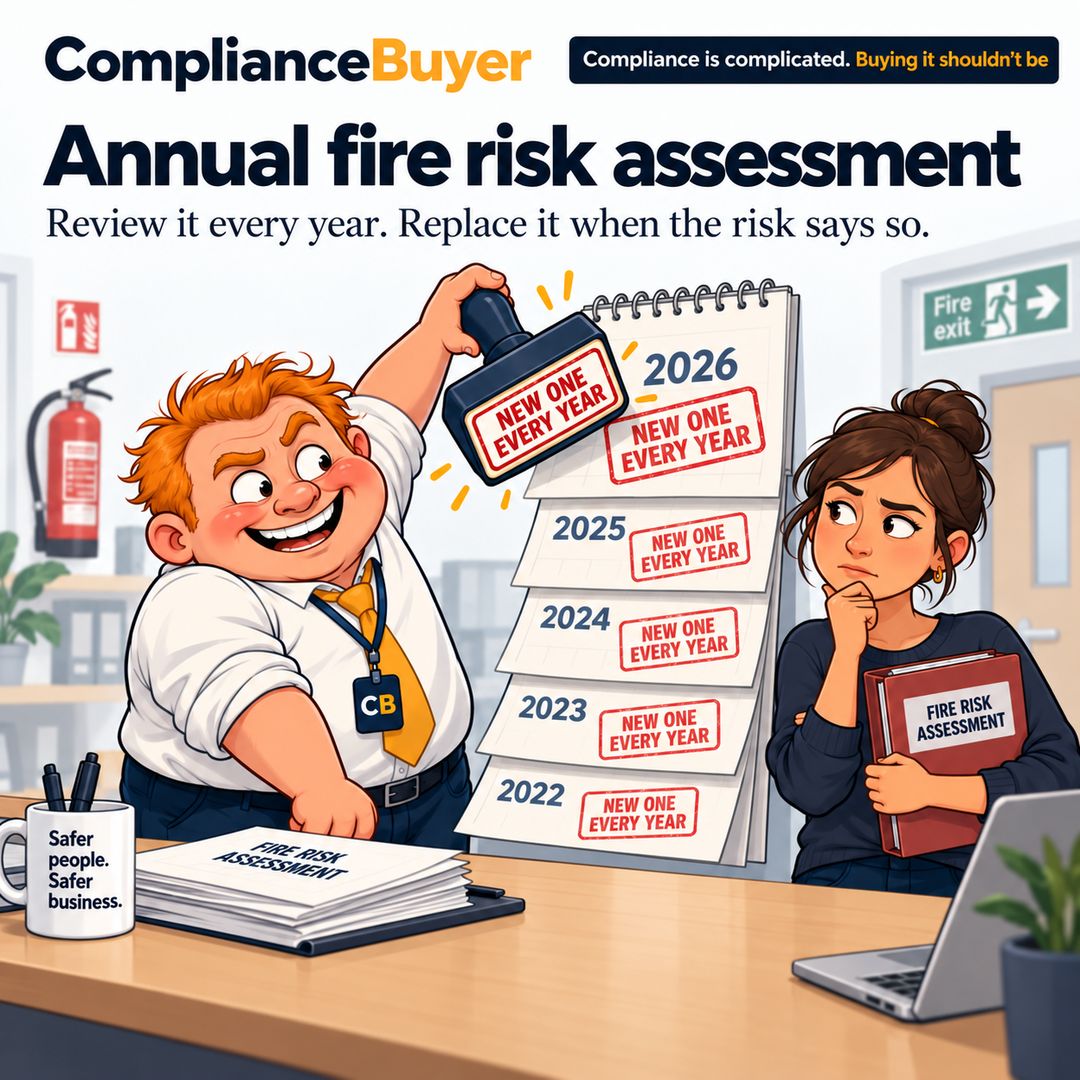
What you were told: "Your fire risk assessment is due for renewal. We'll be out next month, same as last year."
What the law says: The Regulatory Reform (Fire Safety) Order 2005 says you must review your assessment regularly to keep it up to date. You must also review it if you suspect it is no longer valid or something significant has changed. There is no interval. There is no word "annual". There is no word "renewal".
The assessment and the review are different jobs
A suitable and sufficient assessment of the fire risk recorded in full. In England and Wales that has applied to every responsible person since October 2023 whatever the size of the business. Scotland and Northern Ireland have their own fire law. There the significant findings must be written down if you have five or more employees, need a licence or are under an alterations notice. For anything beyond a small simple premises use a competent assessor on a recognised register.
You do this once a year and after any change. Walk the premises with the existing assessment in your hand. Is each finding still true? Has each action been done? Has the layout or the number of people or the way you work changed? Date it and sign it. File it with the assessment.
Which kind of premises are you?
This is the part most articles skip. The right answer depends on what you run.
A small shop. One floor and a few staff and a simple layout. Your own yearly review is the right annual job. Have a professional re-do the assessment every three to five years. Have it re-done sooner if you change the layout or start storing something new.
A small office. Much the same as a small shop. Your yearly review is good advice here too. Get a professional back every three to five years or after a refit.
Larger premises. More floors and more people mean more ways for a fire to spread and a longer way out. We recommend an expert re-assess every year or two. Your own review still happens in between.
Higher risk premises. Here we recommend an expert every year. Higher risk means somewhere a fire is more likely to start or more likely to hurt people. A large commercial kitchen is the clearest example. Hot oil and gas and open flame sit next to extraction ducts that fill up with grease. That is a very different risk from a retail shop.
Other higher risk examples are premises where people sleep. That means hotels and care homes and HMOs. It also means flats above a shop that share an entrance with it. It means places that store flammable things like paint and solvents and gas cylinders. It means workshops that do welding or grinding. It means venues that hold big crowds and anywhere with vulnerable people like nurseries. It also means anywhere that charges e bikes or e scooters or keeps a lot of lithium batteries.
After a fire or a near miss or an enforcement visit you should get a full re-assessment whatever kind of premises you are.
Where the money goes
A £300 assessment sold every year to a small shop is £1,500 over five years. The owner could have reviewed it in years two to five and had it redone once. The same annual model sold to a hotel or a busy kitchen is a different matter. There the yearly visit is money well spent.
What you shouldn’t be sold
- The annual "renewal" for a small shop or office. Your review is annual. The professional assessment usually is not.
- A three year contract for annual assessments you do not need. You are buying a service you mostly do not need every year on a term you cannot leave.
- Kit in the same visit. The assessor who finds you need a new alarm panel and quotes for it on the spot has stopped being an assessor.
- The old five employee rule. Anyone still saying you do not need it written down is three years out of date.
Quick answers
- How often does a fire risk assessment need to be redone?
- The law says review it regularly and whenever there is reason to think it is no longer valid. It sets no interval. For a small shop or office your own yearly review is enough with a professional re-assessment every three to five years. Larger premises should have an expert out every year or two. Higher risk premises should have one every year.
- What counts as a review?
- You walk the premises with the existing assessment in your hand. You check each finding is still true and each action has been done. Then you date it and sign it. It takes about an hour and costs nothing.
- Is a commercial kitchen higher risk?
- Yes. Hot oil and gas and grease in the extraction all add up. A busy commercial kitchen should have an expert re-assess it every year.
General information, written for the person paying the bill. Opinion is labelled as opinion. Not legal advice. See our editorial standards.